Tool positioning
<0.6 mm
Observed closed-loop positioning error using total-station feedback.
Positioning experimentConstruction robotics · RA-L 2026
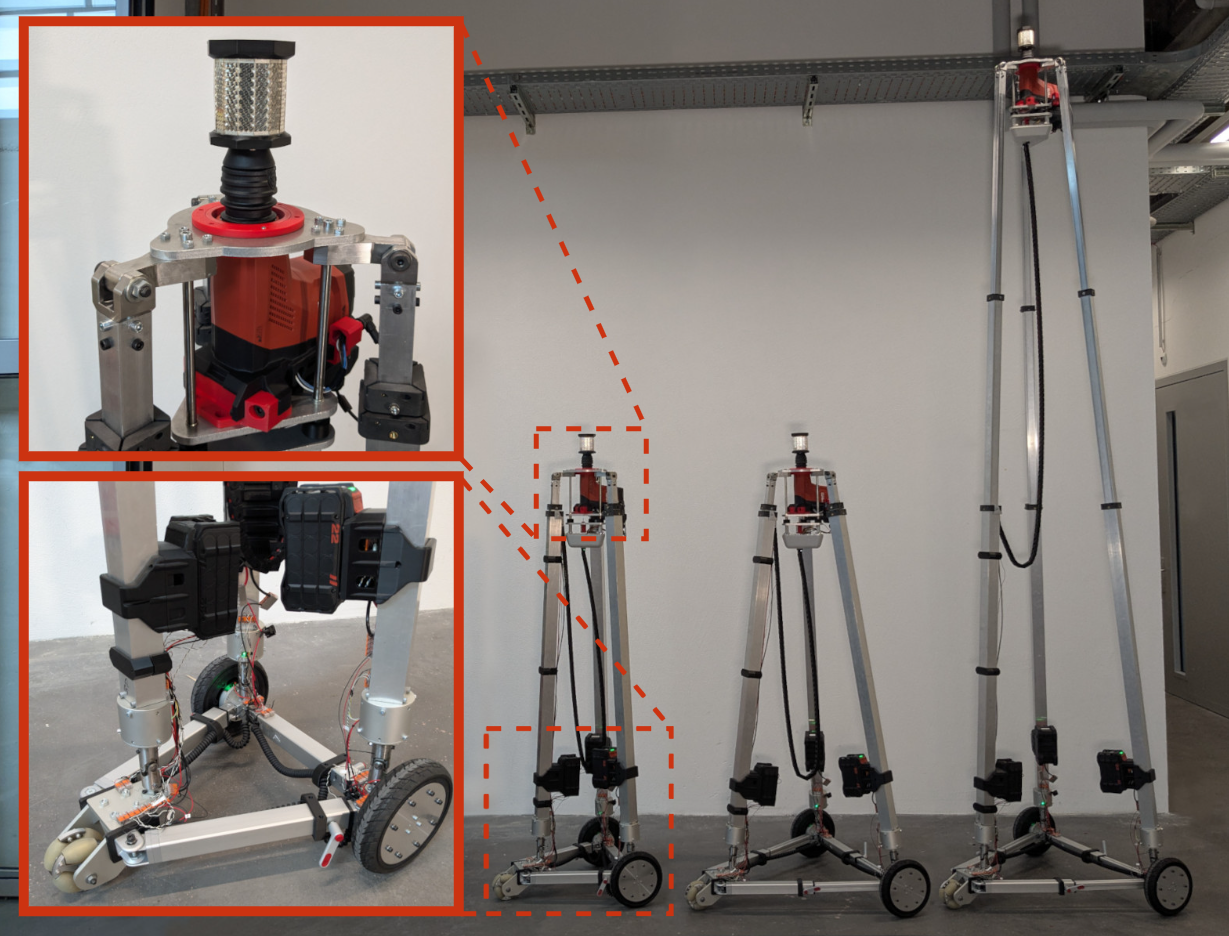
A 33 kg tripod construction robot for overhead tasks. Three extending legs position a drilling tool above a compact wheeled base.
Accepted in IEEE Robotics and Automation Letters, July 2026.
The platform
Tripody is a tripod robot whose three extending legs support and position a shared tool platform. This parallel mechanism provides three degrees of freedom, vertical reach, and a modular tool interface for overhead construction work.
Universal base joints increase resistance to twisting. Small structural deflections accommodate the mechanism’s intentional overconstraint.
The prototype prioritizes reach, stiffness, and portability within a limited horizontal workspace. The mechanical design and operating limits are documented in the paper.
Experimental results
As a ceiling construction robot, Tripody addresses a demanding application of construction robotics: drilling overhead while maintaining accurate positioning and stability under tool loads. The study evaluates positioning and drilling separately.
Tool positioning
Observed closed-loop positioning error using total-station feedback.
Positioning experimentOverhead drilling
Drilled in open loop at 3.2 m. Maximum relative hole-position error: 4.5 mm after rigid alignment.
Drilling experimentThis drilling study establishes task feasibility; it does not measure absolute hole accuracy in a building coordinate frame.
Publication
Tripody: An Overconstrained 3-SPR-like Parallel Robot for High-Reach Construction Tasks
IEEE Robotics and Automation Letters, vol. 11, no. 9, pp. 10497–10504, 2026.